
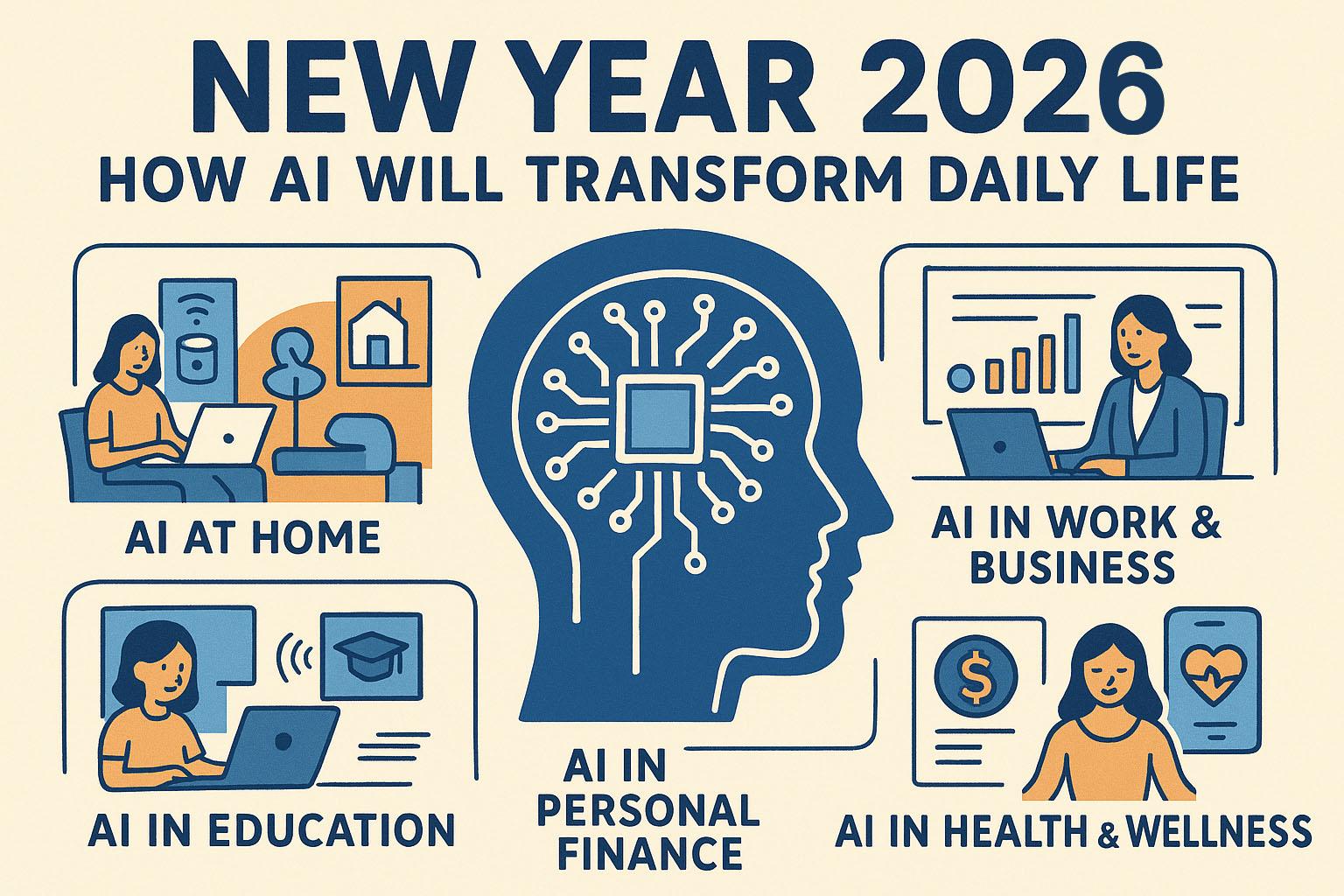
Artificial Intelligence is no longer a futuristic concept—it’s becoming an essential part of everyday life. As we step into New Year 2026, AI is entering a new phase of maturity marked by smarter automation, personalised planning, safer decision-making, and powerful creative tools.
This year will be a turning point where AI moves from being a helpful tool to a seamlessly integrated companion shaping the way we work, learn, shop, communicate, and take care of ourselves.
This in-depth guide explores how AI will transform daily life in 2026, the emerging trends, and what individuals can do to adapt and thrive in an increasingly intelligent world.
1. AI at Home: The Rise of the “Intelligent Household”
Homes in 2026 are becoming more intuitive, with AI systems predicting needs rather than simply responding to commands.
1.1 Smarter Virtual Assistants
Virtual assistants are evolving into proactive home managers.
Instead of waiting for instructions, they now:
- Suggest schedules
- Manage household tasks
- Detect energy waste
- Predict maintenance needs
- Analyse real-time behaviour patterns
A virtual assistant can now say:
“Your fridge temperature is fluctuating. You may want to get it checked.”
1.2 AI-Optimised Energy Management
Smart homes will automatically reduce electricity usage during peak hours and adjust heating based on weather forecasts, lowering energy bills.
1.3 AI-Enhanced Security Systems
AI-powered home security systems can distinguish between guests, pets, delivery workers, and genuine threats—drastically reducing false alarms.
2. AI in Work & Business: Efficiency, Automation, and Innovation
2026 will be the year AI becomes deeply embedded in business workflows, enhancing productivity at every level.
2.1 AI as a Workplace Co-Pilot
Employees will use AI to:
- Summarise meetings
- Generate reports
- Analyse data
- Draft emails
- Plan workdays
- Manage project tasks
This dramatically reduces time spent on administrative tasks.
2.2 AI-Driven Decision Making
AI tools will evaluate risks, simulate outcomes, and provide recommendations—from marketing campaigns to supply chain planning.
2.3 Automated Customer Support
Advanced chatbots can already understand context, emotions, and specific needs.
In 2026, they will:
- Predict customer concerns
- Provide solutions instantly
- Personalise service 24/7
Write name on New Year Wishes and send it to your loved ones.
3. AI in Education: Personalised Learning Becomes the Norm
The learning experience is shifting from standardised models to personalised intelligence-driven education.
3.1 Adaptive Learning Paths
AI analyses each student’s strengths, weaknesses, pace, and preferences to build customised study pathways.
3.2 Real-Time Feedback
AI tutoring tools provide instant corrections, alternative explanations, and practice questions targeted to the learner’s gaps.
3.3 Skill-Focused Development
Students can leverage AI to learn:
- Coding
- Languages
- Mathematics
- Science
- Creative skills like writing, music, and design
AI acts as a constant, patient mentor.
4. AI in Personal Finance: Smarter Money Decisions
Financial wellbeing is one of the most searched topics every January, and AI is reshaping how people manage money in 2026.
4.1 AI-Generated Budgeting Plans
AI tools create real-time budgets based on income, spending patterns, lifestyle, and goals.
4.2 Automated Savings & Investments
AI can suggest investment options, automate recurring savings, and manage diversified portfolios.
4.3 Fraud Detection & Financial Safety
Banks use AI to detect unusual activity instantly, protecting users from scams and fraud—critical in an increasingly digital world.
Send New Year Wishes With name to friends and family for free
5. AI in Health & Wellness: A New Era of Wellbeing
AI will help individuals monitor their physical and mental health more accurately than ever before.
5.1 Intelligent Health Tracking
Wearables powered by AI track:
- Heart rate variability
- Sleep cycles
- Stress levels
- Movement patterns
- Nutrition and hydration needs
These insights allow early detection of potential health concerns.
5.2 AI-Powered Therapy & Mental Wellness Tools
Mental wellness apps now offer:
- Cognitive behavioural therapy (CBT)
- Guided meditation
- Mood tracking
- Stress management plans
All personalised through advanced AI understanding.
5.3 AI-Assisted Fitness & Nutrition Coaching
AI recommends meal plans, workout routines, and daily calorie goals based on body composition and health patterns.
6. AI in Shopping & Daily Services: Personalised Everything
Shopping experiences in 2026 will be shaped heavily by AI.
6.1 Predictive Shopping Recommendations
AI analyses lifestyle data to predict what users may need next—before they even search for it.
6.2 Smarter Online Shopping
Consumers will experience:
- AI-generated outfit ideas
- Personalised skincare recommendations
- Virtual try-ons
- Smart price comparisons
6.3 AI in Travel Planning
AI can create detailed travel itineraries based on budget, preferences, destinations, and season.
7. The Ethical Side of AI: Safety, Transparency & Responsibility
As AI becomes central to everyday life, ethical standards in 2026 will tighten.
7.1 Transparent AI Systems
Governments and companies will be required to disclose:
- How AI makes decisions
- What data it uses
- How users can opt out
7.2 Bias Reduction
AI developers are working to eliminate biases from models to ensure fair outcomes.
7.3 Personal Data Protection
Stricter regulations ensure that individuals have control over their data.
8. How to Prepare for an AI-Driven 2026
Here are practical steps individuals can take to adapt and thrive:
- Learn essential AI tools (assistants, productivity apps, learning platforms)
- Improve digital literacy
- Strengthen human skills (communication, problem-solving, emotional intelligence)
- Build an adaptable mindset
- Stay informed about AI safety and ethics
These steps will ensure a smooth transition into an AI-powered future.
9. High-Search FAQs for New Year 2026 & AI
1. How will AI change life in 2026?
AI will automate tasks, improve decision-making, personalise learning, strengthen home management, and simplify finances.
2. Is AI safe to use in daily life?
Yes—modern AI systems follow strict data protection and ethical guidelines.
3. What skills should I learn in 2026 to stay ahead?
Problem-solving, creativity, digital literacy, emotional intelligence, and understanding AI basics.
4. Will AI replace jobs?
AI will automate repetitive tasks but increase demand for jobs requiring human judgement, creativity, and leadership.
Conclusion
New Year 2026 marks a major transformation in how people live, work, and communicate.
AI is not just a technological upgrade—it’s a powerful shift shaping a smarter, more intuitive world.
For individuals, learning to use AI confidently will unlock greater productivity, wellbeing, and opportunities throughout the year.